
Rhodiola rosea Benefits for Stress, Cortisol & Fatigue
Updated: Apr 23
by Tricia Bell, Clinical Herbalist
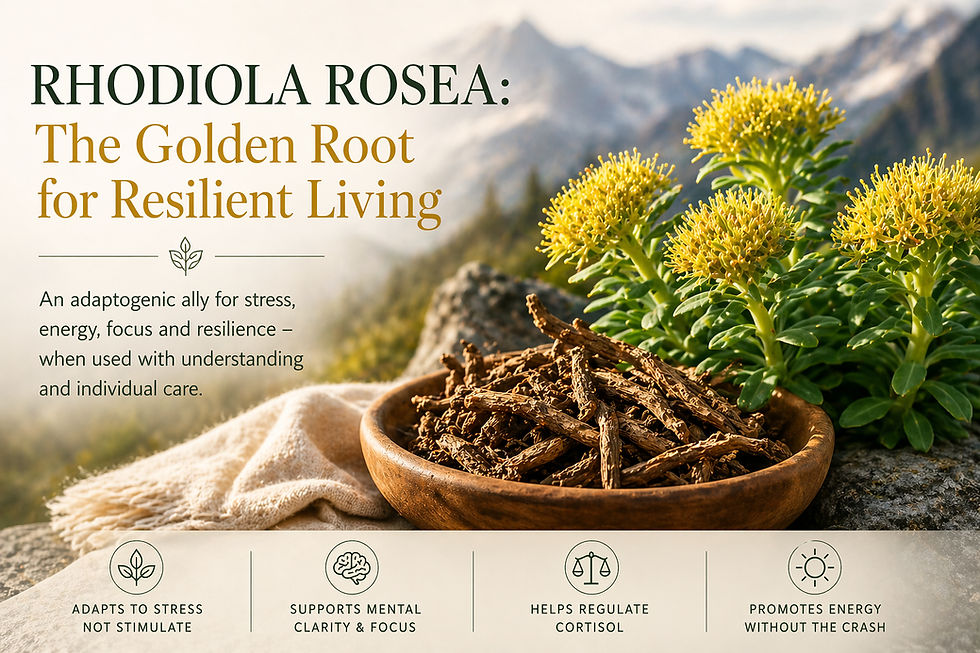
Rhodiola rosea is one of the most well-researched adaptogenic herbs for supporting stress, fatigue, and mental performance.
Often called Golden Root or Arctic Root, Rhodiola has been used traditionally to increase endurance, support cognitive function, and improve resilience in harsh environments.
Today, it is commonly used for:
Stress-related fatigue
High cortisol and burnout
Brain fog and low focus
“Wired but tired” energy
But while Rhodiola is widely recommended, how and when to use it matters.
What Is Rhodiola rosea?
Rhodiola rosea is a cold-climate adaptogenic plant that grows in:
Siberia
Scandinavia
High-altitude regions of Europe and Asia
Alpine regions of Canada, including British Columbia and Alberta
It thrives in extreme conditions — cold, wind, and nutrient-poor soil — which contributes to its resilience-building properties.
Rhodiola Benefits for Stress and Cortisol

One of the most studied benefits of Rhodiola is its effect on the stress response system (HPA axis).
Rhodiola helps regulate cortisol rather than simply lowering it.
Supports reduction of elevated cortisol in chronic stress
Helps restore balance when cortisol is dysregulated or depleted
Improves the body’s ability to adapt to ongoing stress
What the Research Shows
A randomized, double-blind study found Rhodiola significantly reduced stress-related fatigue and improved concentration (Olsson et al., 2009)
Clinical research shows improved mental performance and reduced fatigue under stress (Darbinyan et al., 2000)
Reviews suggest Rhodiola supports stress adaptation and nervous system resilience (Panossian & Wikman, 2010)
Rhodiola for Fatigue and “Wired but Tired”
Rhodiola is particularly helpful when fatigue presents as:
Exhaustion with mental overactivity
Difficulty shutting off
Energy crashes later in the day
Burnout with ongoing demands
Rather than acting like a stimulant, Rhodiola supports:
Mitochondrial energy production
Mental stamina
Stable energy without sharp crashes
Best Form of Rhodiola (Based on Research)
Not all Rhodiola products are the same.
Most clinical studies use standardized extracts containing:
3% rosavins
1% salidroside
These extracts are:
More consistent in effect
Easier to dose
Better supported by research
Other Forms
Tinctures – broader plant profile, more variable potency
Powdered root – traditional, but less concentrated
Capsules – dependent on extract quality
The most common reason Rhodiola “doesn’t work” is poor quality or incorrect form.
How to Take Rhodiola
Take in the morning or early afternoon
Start with a low dose and increase gradually
For some people, Rhodiola can feel stimulating.
In those cases:
Lower the dose
Adjust timing
Or reconsider whether it’s the right herb
The goal is not stimulation — it’s balanced, steady energy.
Sourcing & Sustainability
Rhodiola is a slow-growing alpine plant, making it vulnerable to overharvesting.
In some regions, wild populations are now considered at risk or protected.
Look for:
Cultivated or sustainably harvested Rhodiola
Verified species (Rhodiola rosea)
Transparent sourcing

Why Rhodiola Doesn’t Work for Everyone
This is where most online advice falls short.
Holistic health is not about:
“Take this herb for this symptom”
Because:
Fatigue can come from multiple causes
Stress patterns vary
Nervous systems respond differently
Rhodiola may be ideal for one person — and completely wrong for another.
What matters is:
The underlying pattern
The state of the nervous system
The level of depletion vs overstimulation
When to Work With a me
If you’re dealing with:
Ongoing fatigue
High stress that doesn’t resolve
Brain fog or inconsistent energy
“Wired but tired” patterns … it may be time to look beyond a single supplement.
A personalized approach can help identify:
What your body actually needs
Which herbs are appropriate
How to restore balance long-term

Comments